

- kunal
- brand growth strategy, digital growth strategy, digital marketing strategy, improve website traffic, increase online visibility and sales, online growth strategy, SEO strategy for business growth
- 0 Comments
- 550 Views
Online growth rarely stops for just one reason.
A website may still be getting visitors, but fewer of them are becoming customers. Search rankings may look healthy while enquiries have fallen. Paid campaigns may be bringing in traffic without generating enough revenue. Or perhaps the business has simply reached a point where the tactics that worked during its early stages are no longer producing the same results.
That is where many brands make the wrong move. They see slower growth and immediately try to increase activity: more blogs, more ads, more social posts, more keywords.
Sometimes that works. Often, it simply creates more work around the same underlying problem.
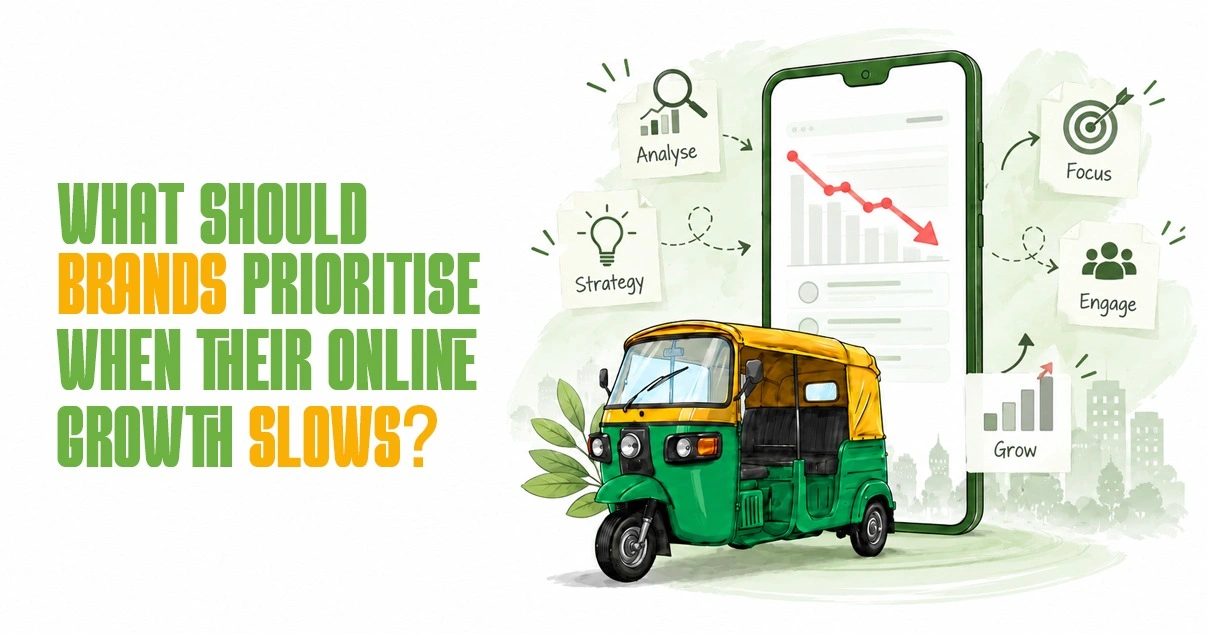
When growth slows, the priority should be understanding what has changed and where the customer journey is losing momentum. From there, a business can decide whether it needs better visibility, stronger content, a smoother website experience, improved conversion rates, or a clearer reason for customers to choose it.
A sensible digital growth strategy is therefore less about doing everything at once and more about putting attention where it can make a measurable difference.
Start With the Problem, Not the Tactic
Before changing a marketing plan, look at the numbers over a meaningful period.
Compare the last six to twelve months with the previous period and ask some straightforward questions:
- Has organic traffic fallen?
- Are rankings declining or simply staying flat?
- Are visitors leaving important pages without taking action?
- Have enquiries decreased even though traffic is stable?
- Are existing customers buying less frequently?
- Has the cost of acquiring a customer increased?
- Are competitors appearing more often for important searches?
- Has the website, product, pricing, or market changed?
This exercise often reveals that the problem is not where the team first assumed it was.
For example, a company may believe it needs more traffic when the real issue is a service page that no longer converts well. Another brand may be investing heavily in social media when most of its qualified customers actually come through search.
That distinction matters because the solution should follow the problem.
Look at What the Business Already Has
When budgets are under pressure, the best opportunity may already be sitting inside the website.
Look at the pages that have historically performed well. Check older articles that still receive impressions. Review landing pages that attract visitors but generate few enquiries. Examine products or services that receive attention but have weak sales.
There is often more value in improving an existing asset than starting another one from scratch.
An old article that ranks on page two, for instance, may need better coverage, clearer answers, updated examples, stronger internal links, or a better connection to the service being offered. A commercial page with strong search visibility may simply need a clearer proposition and fewer barriers to conversion.
This is one of the most practical parts of an online growth strategy because it makes use of assets the business has already invested in.
Traffic Is Not the Same as Growth
Traffic is easy to report because it is easy to measure.
But more visitors do not automatically mean more business.
Imagine a website’s traffic increases by 30%, while enquiries remain unchanged. On paper, the traffic number looks impressive. From a business perspective, something is clearly missing.
This is why brands should track the relationship between visibility and outcomes.
Useful measures include:
- Qualified enquiries
- Conversion rate
- Revenue per visitor
- Customer acquisition cost
- Average order value
- Repeat purchase rate
- Customer lifetime value
- Revenue by acquisition channel
The goal is to understand which activities bring people who are actually useful to the business.
A smaller audience with strong buying intent can be considerably more valuable than a large audience that has little interest in purchasing.
Revisit the Customer Journey
Sometimes the marketing is doing its job. The problem appears after the visitor arrives.
Take a typical service business. Someone searches for a solution, lands on the website, reads about the service, and then wants to know three things:
Can this company solve my problem?
Can I trust it?
What happens if I contact them?
If the website does not answer those questions clearly, the visitor may leave—even if the business ranks well.
Review important pages from a customer’s perspective.
Is the offer understandable within a few seconds? Are the benefits clear? Is there evidence of experience? Are case studies, testimonials, credentials, or useful examples available where they matter? Can someone contact the business without filling out an unnecessarily complicated form?
These details may sound basic, but they often have a greater commercial impact than another round of keyword optimisation.
Do Not Respond to a Traffic Drop by Publishing Randomly
When organic traffic declines, the instinct to publish more content is understandable.
It is also one of the easiest ways to make a website noisier without making it stronger.
Before producing new articles, review what already exists.
Look for:
- Pages that have lost rankings
- Outdated information
- Articles covering almost the same topic
- Pages targeting the wrong search intent
- Important topics competitors cover better
- Commercial pages with weak supporting content
- Content that receives impressions but very few clicks
A good SEO strategy for business growth should create a clear relationship between useful information and the products or services a company provides.
That does not mean turning every article into a sales pitch.
A useful article should solve the reader’s immediate problem. It should also make it clear, where appropriate, what the reader can do next.
That could mean reading a related guide, comparing options, looking at a case study, requesting a consultation, or visiting a relevant service page.
Focus on Search Intent, Not Just Search Volume
High-volume keywords can be attractive because the numbers look impressive.
But search volume does not tell you whether those searches are commercially useful.
Someone searching for a broad term such as “digital marketing” may simply be researching the subject. Someone searching for “digital marketing agency for B2B SaaS” has a much clearer need.
This is where digital marketing strategy needs to work closely with SEO.
Instead of asking only, “How many people search for this keyword?”, ask:
What is this person trying to accomplish?
That question changes the content plan.
Some searches require educational content. Others need comparisons, examples, pricing information, product details, case studies, or direct service pages.
A strong content programme should cover different stages of decision-making rather than producing dozens of articles that all answer variations of the same basic question.
Find Out What Customers Are Actually Asking
Analytics can tell you what people did.
Your customers can tell you why.
Sales calls, support conversations, reviews, emails, enquiries, and customer interviews can reveal questions that keyword tools may never show you clearly.
Maybe prospects keep asking about implementation time.
Maybe they are uncertain about pricing.
Maybe they do not understand the difference between two services.
Maybe they trust the brand but cannot see what makes it different from a cheaper competitor.
Those insights should influence the website and content.
This is where a brand growth strategy becomes much more practical. Instead of developing messaging in a conference room and hoping customers respond, businesses can build communication around real concerns people raise before buying.
Strengthen the Pages Closest to Revenue
Not every page on a website deserves equal attention.
If growth has slowed, identify the pages closest to a commercial action.
These might include:
- Service pages
- Product pages
- Pricing pages
- Comparison pages
- Case studies
- Location pages
- High-intent landing pages
Then examine how much traffic they receive and how effectively they convert it.
A business could have hundreds of blog posts but only five pages responsible for most enquiries. In that situation, improving those five pages may have a much greater impact than publishing another twenty articles.
This does not mean informational content is unimportant. It means content should have a purpose within the wider customer journey.
Think About Retention, Not Just Acquisition
Growth conversations often focus heavily on finding new customers.
That can be expensive.
If existing customers are satisfied, there may be opportunities to generate more value from those relationships through repeat purchases, renewals, additional services, referrals, or relevant recommendations.
Look at:
- How often customers return
- Where customers stop engaging
- Which products or services they buy together
- Whether follow-up communication is useful
- Why customers cancel or do not return
- Whether loyal customers are being rewarded
For many companies, improving retention by a small amount can have a meaningful effect on overall profitability.
That makes retention an important part of online business growth, particularly when acquisition costs are rising.
Do Not Ignore Brand Recognition
There is another reason growth can become harder: the market becomes crowded.
When several companies offer similar products or services, being visible is no longer enough. Customers need a reason to remember and choose one brand over another.
That reason might come from expertise, product quality, service, convenience, price, specialist knowledge, customer experience, or a distinctive point of view.
The exact differentiator will depend on the business.
What matters is that the difference is clear.
A company that says it provides “high-quality solutions for modern businesses” has not really differentiated itself. A company that can clearly explain who it serves, what problem it solves, how it works, and why customers choose it has something much more useful.
What to Do When Website Traffic Drops
If traffic suddenly falls, avoid making several major changes at once.
First, identify where the decline occurred.
Compare organic, paid, direct, referral, and social traffic separately. Then look at the pages affected.
For organic search, check impressions, clicks, rankings, indexed pages, and important queries. Review whether technical changes were recently made to the website. A redesign, URL change, migration, incorrect canonical, indexing issue, or other technical problem can create a significant visibility change.
Google also recommends examining traffic drops systematically rather than assuming the cause immediately. Its current Search documentation continues to emphasise diagnosing changes and improving the underlying site rather than chasing shortcuts.
Also check competitors.
If several competitors have experienced a similar decline, the issue may be market-wide. If your competitors are growing while your site is losing visibility, the competitive gap deserves closer attention.
How to Improve Website Traffic Without Chasing Every Keyword
To improve website traffic, concentrate on topics where your business can genuinely offer something useful.
That could involve refreshing older pages, improving internal linking, creating original research, answering customer questions, developing better supporting resources, or expanding into closely related topics.
Do not create separate pages simply because two keywords look slightly different.
If two searches represent essentially the same need, one strong page may be more useful than two thin pages.
This also reduces the risk of creating a website full of repetitive content that provides little additional value.
Google’s current guidance places emphasis on useful, people-first content and warns against approaches intended primarily to manipulate search visibility.
How to Grow an Online Business When Resources Are Limited
If you are thinking about how to grow an online business without continually increasing the marketing budget, start with efficiency.
Improve pages that already receive qualified traffic. Turn successful articles into newsletters, videos, social posts, sales resources, or downloadable guides. Reconnect with previous customers. Improve the conversion process on high-value pages.
You can also look at the customers who generate the most value.
Where did they come from?
What did they read before contacting you?
What objections did they have?
What convinced them?
These answers can help the business invest more heavily in the parts of the journey that already show signs of working.
Sociostreet’s approach to digital marketing can be viewed through this same lens: individual channels should not operate in isolation. SEO, content, branding, social media, and performance marketing become more useful when they support the same commercial objective.
How to Increase Online Visibility and Sales at the Same Time
Visibility and sales are connected, but they are not identical.
To increase online visibility and sales, a brand needs content for people who are discovering the problem as well as people who are already comparing solutions.
For example, an educational article might attract someone researching a problem for the first time. From there, relevant internal links can take that visitor towards a case study, service page, product comparison, or consultation page.
The journey should feel natural.
A reader should never feel as though an article was created simply to push them towards a sales page.
Useful information builds the first layer of trust. Strong evidence builds the second. A clear offer and straightforward next step complete the journey.
What a Practical Recovery Plan Looks Like
Once the problem is understood, avoid creating a 20-point action plan.
Choose a small number of priorities.
For example:
First: Fix major technical or conversion problems.
Second: Improve pages that already have search visibility or commercial potential.
Third: Strengthen content around genuine customer questions.
Fourth: Improve retention and follow-up with existing customers.
Fifth: Measure outcomes rather than activity.
Give each priority a clear metric.
If conversion optimisation is the focus, measure conversion rate and qualified leads. If SEO is the focus, look beyond rankings and track relevant organic traffic and revenue. If retention is the focus, measure repeat purchases, renewals, or customer lifetime value.
That makes progress much easier to judge.
How to Improve Online Business Growth Over Time
There is no permanent formula for growth.
Markets change. Customers change. Competitors change. Search behaviour changes. Even a strategy that worked extremely well last year may need to be adjusted today.
The businesses that tend to handle these changes well are not necessarily the ones doing the most marketing. They are the ones paying attention to what their customers are doing and responding quickly when the evidence changes.
Ask these questions regularly:
- Are we reaching the right people?
- Are they finding useful information?
- Do they understand our value?
- Is the website making the next step easy?
- Are customers returning?
- Which channels actually generate business?
- What should we stop doing?
The answers create the foundation of a sustainable digital growth strategy.
Final Thoughts
A slowdown in online growth is not automatically a sign that a brand needs more content, more advertising, or more social activity.
It may simply mean that one part of the customer journey is no longer working as well as it once did.
Start with the evidence. Find the point where momentum has weakened. Fix that area before adding more activity.
For one company, the answer may be a better website. For another, it may be stronger search visibility, clearer positioning, better retention, or a more focused acquisition strategy.
The important thing is not to confuse activity with progress.
A thoughtful digital growth strategy helps a brand make better decisions about where its time, money, and attention should go. And when growth begins to slow, that clarity can be more valuable than another campaign.
FAQs
What should a brand do first when online growth slows?
Start by identifying exactly what has changed. Check traffic sources, conversions, revenue, rankings, customer retention, and website behaviour before deciding whether the problem is related to SEO, marketing, the website, or customer demand.
What is a digital growth strategy?
A digital growth strategy is a plan for improving a company’s online visibility and commercial performance. It can bring together SEO, content, paid marketing, website optimisation, branding, customer retention, and conversion improvements around measurable business goals.
How can an online growth strategy improve business performance?
An online growth strategy helps businesses decide where to concentrate resources. Instead of treating every marketing channel equally, it identifies the activities most likely to improve qualified traffic, conversions, revenue, or customer retention.
What should you do when website traffic drops?
If you are wondering what to do when website traffic drops, first identify which channel and pages lost traffic. Then review search performance, technical SEO, recent website changes, seasonality, competitors, and indexing before making significant changes.
How can SEO support business growth?
An SEO strategy for business growth can help a brand become visible when potential customers are actively looking for information, products, or services. The strongest approach connects useful content with commercially relevant pages rather than focusing only on rankings.
What makes a good brand growth strategy?
A brand growth strategy should make it clear who the business serves, what problem it solves, why customers should trust it, and what makes it different. That positioning should remain consistent across the website, content, advertising, social channels, and customer experience.
How can a small company grow an online business?
When considering how to grow an online business, start with existing assets. Improve pages that already receive traffic, fix conversion barriers, refresh useful content, reconnect with previous customers, and invest in channels that consistently bring qualified prospects.
How can businesses improve online business growth?
Understanding how to improve online business growth starts with finding the biggest constraint. A business should review acquisition, conversion, retention, customer value, and channel profitability before deciding where additional investment is needed.
How can a company increase online visibility and sales?
To increase online visibility and sales, create useful content for people at different stages of the buying journey. Educational content can attract new audiences, while service pages, product information, comparisons, case studies, and clear calls to action can support purchasing decisions.
Should brands focus on SEO or digital marketing when growth slows?
They should not necessarily choose one over the other. SEO can strengthen long-term organic visibility, while a broader digital marketing strategy can combine search, paid media, social, email, content, and other channels. The right priority depends on where the business is currently losing momentum.