


- kunal
- Digital Marketing for Lead Generation, Lead Generation for Businesses, SEO, Website Conversion Rate, Website Traffic Conversion
- 0 Comments
- 33 Views
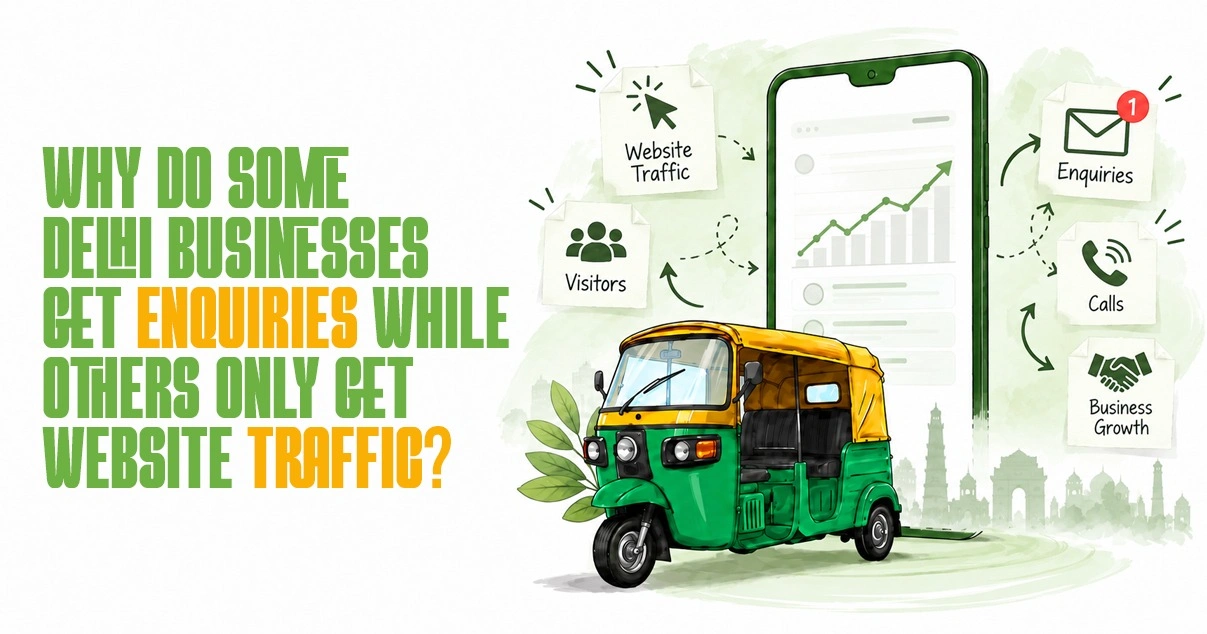
Two businesses can rank for similar searches, attract a similar number of visitors, and still end the month with very different results.
One receives calls, WhatsApp messages, form submissions, and consultation requests. The other keeps watching its traffic graph climb but hears very little from potential customers.
The difference is rarely traffic alone.
For most service businesses, the real challenge is turning the right visitor into a person who is willing to take the next step. A website can attract thousands of visits and still fail to create meaningful business opportunities if the page does not match the visitor’s intent, answer their concerns, or make contacting the business easy.
That is where lead generation for businesses becomes more important than simply chasing higher traffic numbers.
Traffic is only the beginning.
Website traffic tells you that people are reaching your site. It does not tell you whether they are the right people, whether they trust the business, or whether they understand what to do next.
Imagine a Delhi-based interior design company receiving 8,000 monthly visits. At first glance, that sounds positive. But if most visitors are looking for decoration ideas, free design inspiration, or generic information, those visits may have little commercial value.
Now consider another company receiving 2,500 visits. Its pages target people actively searching for residential interior designers, commercial projects, and consultation services. The traffic is smaller, but the visitors have a stronger reason to enquire.
This is the practical difference between website traffic vs. lead generation.
The better question is not “How many people visited?” It is “How many relevant visitors had a genuine reason to contact us?”
Why businesses get traffic but no leads
When a website attracts visitors but produces few enquiries, the problem usually sits somewhere between search intent and conversion.
Here are some of the most common reasons.
1. The page attracts the wrong audience
A page may rank well for a broad keyword without reaching people who are ready to buy.
For example, someone searching “digital marketing ideas” may be researching for a college project. Someone searching “digital marketing agency for lead generation in Delhi” has a much clearer commercial intent.
Good lead generation for businesses starts by understanding this difference.
Traffic from informational searches is not useless. It can build awareness and trust. But it should not be judged by the same conversion expectations as high-intent commercial traffic.
2. The website explains the service but does not sell the next step
Many service websites spend considerable space describing what they do and very little explaining what happens after someone makes contact.
A visitor may understand the service but still wonder:
- What happens after I submit the form?
- Will someone call me?
- Can I discuss my requirements first?
- How quickly will I receive a response?
- Is this service suitable for my business?
- What information should I share?
Removing these uncertainties can have a bigger impact than adding another paragraph about the company.
3. The value proposition is too vague
“Complete digital solutions for modern businesses” sounds polished but tells a potential customer very little.
A stronger message identifies the problem, audience, and expected outcome.
For example:
“Help Delhi service businesses turn high-intent website visitors into qualified enquiries.”
That statement gives the reader a clearer reason to continue.
Your website conversion rate can reveal the real problem
A useful website conversion rate is not simply a number to improve every month. It needs context.
A site with 1,000 highly relevant visitors and 50 enquiries may be healthier than a site with 20,000 visitors and 30 enquiries.
The first business is attracting fewer people but creating more opportunities.
When reviewing a website conversion rate, look beyond the overall percentage. Check which pages generate enquiries, which traffic sources perform best, which devices visitors use, and where people leave the site.
A landing page receiving 3,000 visits and generating no meaningful action deserves more attention than a blog receiving 10,000 visits and serving mainly informational intent.
Search intent matters more than raw traffic.
A strong lead generation strategy begins before someone reaches the website.
It starts with understanding what the person actually wants when they search.
Consider these three queries:
“what is digital marketing”
“digital marketing agency Delhi”
“digital marketing agency Delhi for B2B lead generation”
They may belong to the same broad topic, but they represent very different levels of intent.
The third searcher is much closer to a commercial decision.
That does not mean every page should target bottom-of-funnel keywords. A healthy website can have educational content, comparison pages, service pages, and location-focused pages.
The important thing is knowing what role each page plays.
What effective lead generation looks like on a Delhi website
Local relevance can also influence whether a visitor feels that a business understands their situation.
Someone searching for a service in Delhi may want more than a generic national provider. They may care about local markets, customer behaviour, competition, service areas, communication and turnaround times.
This does not mean repeatedly inserting “Delhi” into every paragraph.
Instead, useful local context can appear through examples, case studies, service areas, customer questions and industry-specific problems.
For businesses targeting local customers, digital marketing for lead generation should connect visibility with an actual commercial journey.
A person discovers the business, understands the offer, finds evidence that the company can solve their problem, and then sees an obvious next step.
That journey is more valuable than simply increasing sessions in Google Analytics.
Make converting website visitors into leads easier
A surprisingly common problem is friction.
The visitor is interested, but the website makes the next action unnecessarily difficult.
A form may ask for ten fields. A phone number may be hidden. A WhatsApp option may not exist on mobile. A consultation button may use vague wording such as “Submit.”
Small details can change behaviour.
Instead of asking visitors to “Submit,” a service business might use:
“Request a consultation”
“Discuss your project”
“Get a tailored proposal”
“Talk to a specialist”
The best option depends on the service and the visitor’s intent.
Converting website visitors into leads is therefore not about forcing people to contact a business. It is about reducing uncertainty at the moment they are ready to act.
How to get more enquiries from a website without simply buying more traffic
Businesses often respond to low enquiries by increasing advertising or publishing more content.
That may help, but it is not always the first move.
Start with the pages already receiving relevant traffic.
Check:
- Which pages attract commercial visitors?
- Which pages have strong impressions but weak engagement?
- Where do visitors leave?
- Are service benefits clear above the fold?
- Is there enough evidence to build trust?
- Can visitors contact the business easily on mobile?
- Does the call to action match the page intent?
- Are forms asking for genuinely necessary information?
These checks can reveal opportunities that are hidden behind the headline traffic number.
For companies asking how to increase website enquiries, improving existing high-intent pages can sometimes be more useful than publishing another dozen generic articles.
Content should answer the question behind the question
This is particularly important as search becomes more conversational.
People do not always search with the exact phrase they eventually use when contacting a business.
Someone might search:
“why is my website getting traffic but no leads?”
Then move towards:
“how do I improve website enquiries?”
And eventually search for:
“lead generation agency in Delhi.”
A useful content strategy connects these stages rather than creating isolated pages for every keyword variation.
This also creates stronger topical relevance for search systems because the website demonstrates understanding of the wider subject rather than repeating one phrase.
The goal of website traffic conversion is not to turn every visitor into a customer. It is to recognise which visitors have commercial potential and give them a sensible path forward.
Why website traffic and enquiries should be measured together
Traffic and enquiries answer different questions.
Traffic asks:
“Are people finding us?”
Enquiries ask:
“Are the right people taking action?”
Neither metric tells the whole story by itself.
A business should ideally monitor organic traffic, landing-page performance, enquiry volume, qualified leads, source, conversion paths, and eventual sales.
This helps identify whether the issue is visibility, relevance, conversion, or sales follow-up.
For example, if organic traffic is increasing but qualified enquiries remain flat, publishing more content may not solve the underlying problem.
The business may need better commercial pages, stronger calls to action, improved messaging, or a closer match between search intent and the service being promoted.
A better approach to lead generation for businesses
There is no universal conversion formula because different industries have different buying cycles.
A ₹2,000 service and a ₹20 lakh B2B contract should not use the same enquiry journey.
For a low-friction service, a visitor may be comfortable requesting a quote immediately.
For a high-value service, the first conversion might simply be booking a discovery call or downloading a detailed capability document.
That is why lead generation for businesses should be built around the customer’s decision process rather than a fixed website template.
Sociostreet, for example, can approach this kind of challenge by looking beyond traffic volume and examining how search intent, messaging, content, and conversion points work together.
The strongest strategy is usually the one that connects these elements instead of treating SEO, content, and conversion as separate activities.
What changes when SEO and conversion work together?
Traditional SEO often focuses heavily on rankings, impressions, and traffic.
Those metrics still matter, but they are only part of the commercial picture.
A page can rank well and still underperform if the visitor cannot quickly understand:
- What the business offers
- Who the service is for
- Why the business is credible
- What makes the offer relevant
- What the visitor should do next
Modern search also makes clear answers increasingly important. Search experiences can surface information directly, including through AI-powered features, so content needs to be genuinely useful rather than written simply to repeat keywords.
That makes clarity more valuable than padding.
A well-structured page should answer the main question early, provide supporting detail, address objections, and give readers a logical next action.
The real gap is often between discovery and decision
When one Delhi business receives enquiries, and another only sees traffic, the difference may not be their ability to attract visitors.
It may be what happens after the click.
The better-performing website understands intent, communicates a specific value proposition, builds confidence, and removes friction from the enquiry process.
That is the foundation of website traffic conversion.
Instead of asking only how to bring more people to a website, businesses should ask whether the existing audience has a clear reason to take the next step.
That shift changes the entire approach to digital growth.
More traffic can make the numbers look better.
More relevant traffic, a clearer offer, and a smoother conversion path can make the business perform better.
FAQs
What is the difference between website traffic and lead generation?
Website traffic measures visits to a website, while lead generation focuses on turning relevant visitors into potential customers. The important distinction is intent: a high number of visits does not automatically mean a business is attracting people who are ready to enquire.
Why do businesses get traffic but no leads?
Common causes include irrelevant traffic, unclear messaging, weak service pages, complicated forms, missing calls to action, limited trust signals, and poor alignment between search intent and the page. The first step is finding where relevant visitors stop moving towards an enquiry.
How can I improve my website conversion rate?
Review high-traffic commercial pages first. Make the offer clearer, strengthen proof such as case studies or testimonials, simplify forms, improve mobile usability, and make the next action obvious. Measure changes against qualified enquiries rather than clicks alone.
What makes a good lead generation strategy?
A good lead generation strategy connects the right audience with the right offer at the right stage of the buying journey. It combines search intent, useful content, landing-page experience, clear calls to action, trust signals, and consistent follow-up.
How does digital marketing help generate enquiries?
Effective digital marketing for lead generation brings together channels such as organic search, paid campaigns, social media, content, and email around a defined customer journey. The objective is not simply to generate attention but to create opportunities that the sales team can actually pursue.
What is the best way to increase online enquiries for businesses?
Start with the pages already attracting relevant visitors. Improve their messaging, calls to action, trust elements, and contact options before assuming that more traffic is required. This approach can uncover conversion opportunities without increasing acquisition costs immediately.
How important is converting website visitors into leads?
It is important when the website is expected to contribute directly to sales. Converting website visitors into leads means giving commercially relevant visitors a clear and low-friction path to enquire, while allowing informational visitors to continue learning without being pressured.
How can businesses increase enquiries without increasing website traffic?
Improving existing service pages, simplifying forms, strengthening calls to action, adding credible proof, and matching content more closely to commercial intent can improve enquiry volume without requiring a major increase in traffic.
What should businesses measure besides website traffic?
Businesses should track qualified enquiries, landing-page conversions, lead sources, conversion rates, sales-qualified leads, and eventually revenue. Looking at these metrics together gives a more useful picture than traffic alone.
How does Sociostreet approach lead generation for businesses?
Sociostreet can look at the complete path from search visibility to enquiry rather than treating traffic as the final goal. That means examining search intent, content relevance, website messaging, conversion points, and the experience a potential customer has before making contact.