


- kunal
- Agricultural B2B Marketing, Agricultural Marketing Company, Agricultural Product Branding, Agricultural Product Marketing, Agriculture Marketing Agency, Digital Marketing for Agriculture
- 0 Comments
- 234 Views
An agricultural product can be technically brilliant and still be difficult to sell.
Not because the product is weak. Often, the problem is the way it is explained.
A product team might know every ingredient, specification, application method, certification, and performance detail. A farmer, dealer, or distributor, however, may be asking a much simpler question:
“Why does this product matter to me?”
That gap between technical knowledge and everyday understanding is where agricultural marketing becomes interesting.
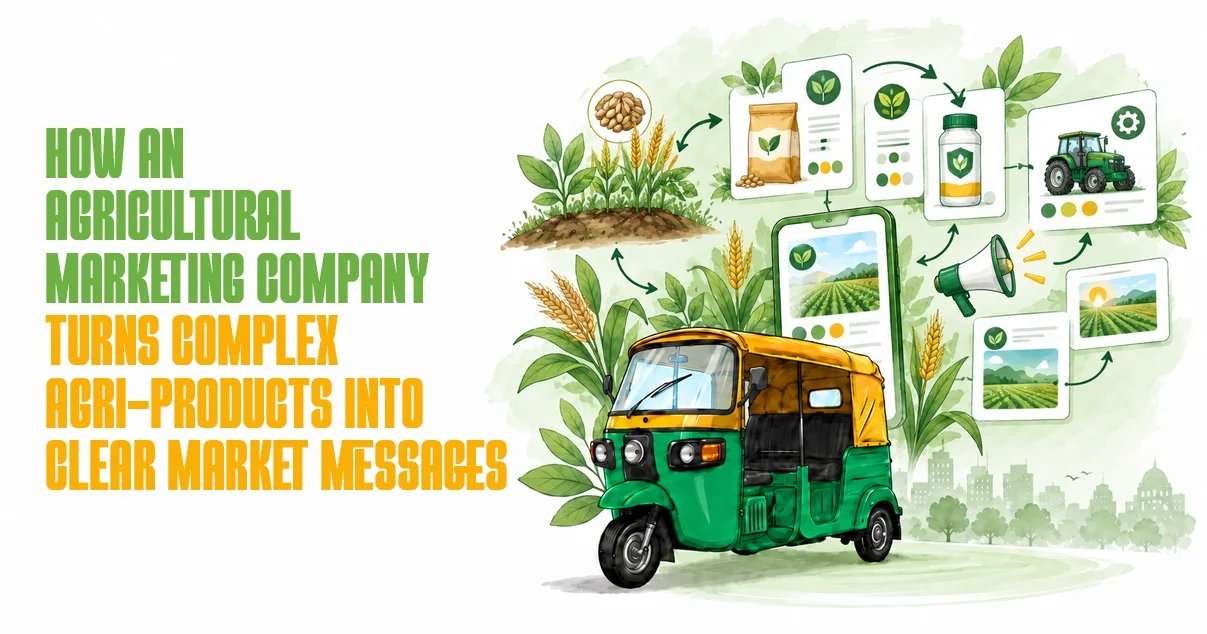
An agricultural marketing company has to take information that may have been created for scientists, agronomists, manufacturers, or technical teams and turn it into something a customer can quickly grasp.
The trick is not to remove the technical substance. It is to give that substance a clearer route to the audience.
Why Complex Agri-Products Often Become Difficult to Market
Agriculture has no shortage of technically detailed products.
There are crop protection solutions, seeds, fertilisers, irrigation equipment, machinery, biological products, animal nutrition products, farm technologies and specialised inputs. Each can involve terminology that makes perfect sense to an industry expert but feels unfamiliar to someone encountering the product for the first time.
A typical product description might lead with:
- formulation
- technical specifications
- application rate
- composition
- compatibility
- certification
- operating parameters
All of that may be necessary.
But it may not be the best opening.
A buyer is usually trying to connect the information with a practical situation. They want to know what the product is for, whether it fits their needs, how it works, what makes it different, and where they can get reliable guidance.
That is why modern agricultural marketing is less about repeating product information and more about organising it around customer questions.
The First Question Is Not “What Are We Selling?”
It is “Who needs to understand this?”
The same agricultural product can be presented differently to a farmer, dealer, distributor, procurement manager, or technical professional.
A farmer may want to know how the product fits a particular crop or farming situation.
A dealer may need a short explanation that can be used during a customer conversation.
A distributor may care about product differentiation, market demand, and portfolio fit.
A technical buyer may want detailed specifications and supporting documentation.
The product has not changed.
The communication has.
This is one of the first things an agriculture marketing agency should establish before creating a campaign: who is actually reading, watching, or hearing the message, and what information will help that person move forward?
Without that clarity, marketing tends to become a pile of product facts.
How to Market Agricultural Products Without Sounding Like a Product Catalogue
When asking how to market agricultural products, many businesses immediately think about advertising.
Advertising is only one part of the answer.
Before deciding where the product should appear, marketers need to decide what the audience should remember after seeing it.
A useful starting point is surprisingly simple:
Problem → relevance → product → evidence → action
Suppose an agricultural input is designed for a specific crop situation.
Instead of beginning with a long technical description, the communication can first establish the situation the audience recognises. The product can then be introduced as a relevant option, followed by the supporting details that help the buyer assess it.
This creates a natural information hierarchy.
People who only need the basic answer can stop early.
People who need proof or technical information can continue.
That is a much more useful experience than forcing every visitor through the same wall of specifications.
How to Market Agri Products When There Is More Than One Buyer
The question of how to market agri products becomes more complicated because agricultural supply chains are rarely linear.
Manufacturers, distributors, dealers, retailers, farmers, and institutional buyers may all play different roles.
A message that works for one group may not work for another.
For example, a dealer-facing campaign could focus on product differentiation and customer demand, while farmer-facing content might explain application, suitability and practical use.
That does not mean creating a completely different brand story for everyone.
The central proposition should remain consistent.
What changes is the emphasis.
An agricultural marketing company can build a core messaging framework and then adapt it for different audiences, channels, and stages of the buying journey.
This is particularly useful when a business has a large product portfolio and several customer groups.
How Agricultural Products Are Marketed Before the Buyer Ever Contacts Sales
People often start researching long before they speak to a salesperson.
They may search a product category on Google, watch an agricultural video, ask a dealer for information, compare brands, browse a product page, or encounter a social media post.
So, how agricultural products are marketed today is partly a question of information availability.
If someone has a basic question about a product and the brand provides no useful answer online, another source may fill that gap.
This is why product pages should not read like digital brochures.
A useful page can answer:
- What is the product?
- What problem is it designed to address?
- Who is it intended for?
- Where is it appropriate?
- How is it used?
- What makes it different?
- What supporting information is available?
- What should the customer do next?
The answer does not need to be buried under marketing language.
Clear beats complicated.
How to Explain Agricultural Products to Customers Who Are Not Technical Experts
Knowing how to explain agricultural products to customers is partly about knowing what not to lead with.
Technical language has a place. It simply does not have to carry the entire conversation.
Imagine explaining a product to someone who has never heard of it.
You would probably begin with its purpose rather than its complete technical specification.
Digital content should work the same way.
Start with the customer situation.
Then introduce the product.
Then explain the relevant benefit.
Then provide technical depth for readers who need it.
Charts, diagrams, short videos, crop-stage illustrations, and product demonstrations can also help translate complex information into something easier to process.
The goal is not to “dumb down” the product.
It is to remove unnecessary effort from understanding it.
Agricultural Product Marketing Needs Proof, Not Just Promises
Strong agricultural product marketing does not depend entirely on persuasive language.
Agricultural buyers often have practical reasons to question a claim.
If a brand says a product is efficient, what does that mean?
If it says the product improves performance, under what conditions?
If it highlights a particular technology, what does that technology actually change?
Good marketing anticipates these questions.
Relevant technical documentation, demonstrations, certifications, research where applicable, usage information, and transparent product details can give the audience something concrete to evaluate.
This is also where marketing and technical teams need to work together.
The marketing team understands communication.
The technical team protects accuracy.
Neither should operate in isolation.
How to Simplify Agricultural Product Messaging Without Losing the Technical Detail
There is a difference between simple and simplistic.
Simple communication removes friction.
Simplistic communication removes useful information.
For complex agricultural products, a layered approach usually works better.
Layer 1: The quick explanation
One or two sentences answering what the product is and why someone might care.
Layer 2: The practical details
Information about use cases, application, suitability, benefits, and important considerations.
Layer 3: The technical material
Detailed specifications, documentation, research, certifications, and other supporting information.
This approach works especially well on websites.
A farmer looking for a quick answer does not have to read a technical paper. A professional who needs deeper information can access it without having to search elsewhere.
That is a better balance between accessibility and expertise.
How Agriculture Brands Communicate Product Benefits Without Overclaiming
The question of how agriculture brands communicate product benefits is not simply about writing stronger headlines.
It is about making the connection between a product feature and a customer need obvious.
Consider a feature such as a particular formulation.
The useful marketing question is not just:
“What is the formulation?”
It is:
“Why does this matter to the intended user?”
That shift changes the copy.
The same principle applies to machinery, irrigation technology, seeds, crop inputs, and agricultural software.
A feature becomes meaningful when the audience understands its practical relevance.
At the same time, claims need to remain supportable. A clear explanation is more credible than an exaggerated promise that raises questions the brand cannot answer.
Digital Marketing for Agriculture Starts With Questions People Already Ask
The best agricultural content ideas are often sitting inside customer conversations.
Sales teams hear them.
Dealers hear them.
Technical representatives hear them.
Customer support hears them.
Those questions can become valuable digital content.
For example:
- How is the product used?
- When should it be applied?
- Which crops is it intended for?
- How does it differ from another product?
- What should users check before application?
- What does a particular technical term mean?
- Which factors affect product selection?
This makes digital marketing for agriculture more useful than simply publishing promotional updates.
A brand can build product awareness while also becoming a source of practical information.
And when people later encounter the product through a dealer or sales representative, some of the explanation has already happened.
Agricultural B2B Marketing Has to Support Longer Decisions
Agricultural B2B marketing often involves several people rather than one immediate buyer.
A manufacturer might need to convince distributors.
The distributor may need to support dealers.
The dealer may need to explain the product to customers.
That means marketing material should be usable at more than one point in the chain.
A technical product page might support research.
A one-page sales sheet might support a dealer conversation.
A short video might explain the product visually.
A case study might provide additional confidence.
A sales presentation might help during a commercial discussion.
These assets do not need identical wording, but they should communicate the same underlying product story.
How to Create an Agricultural Marketing Strategy That People Can Actually Use
When considering how to create an agricultural marketing strategy, start with the product and work outward.
1. Identify the audience
Separate users, buyers, influencers, distributors, and dealers where necessary.
2. Find the real customer problem
Do not assume the product feature is the problem. Find out what the audience is actually trying to solve.
3. Build one clear product proposition
Give the product a simple, defensible reason for being considered.
4. Create supporting evidence
Bring in specifications, demonstrations, documentation, research, or other relevant proof.
5. Match content to the buying stage
Someone discovering a product needs different information from someone comparing suppliers.
6. Select channels based on behaviour
Search, social media, video, dealer networks, email, trade publications and offline material can each have different jobs.
7. Keep measuring what matters
Traffic is useful, but qualified enquiries, product-page engagement, dealer interest and sales conversations can tell you much more about whether the marketing is doing its job.
This approach creates a marketing system rather than a collection of disconnected campaigns.
How to Position Agricultural Products in the Market
The question of how to position agricultural products in the market starts with understanding the alternatives.
- What are customers currently using?
- What do competitors emphasise?
- What does the audience consider important?
- Where does the product have a genuine difference?
The answer might be related to technology, application, support, product range, distribution, formulation, convenience, or another verifiable characteristic.
But positioning should be specific.
“Premium quality” tells a customer very little.
A clearly explained product characteristic backed by relevant evidence gives them something they can actually evaluate.
Good positioning does not try to make a product everything to everyone.
It gives the market a clear reason to remember it.
Agricultural Product Branding Is More Than Packaging
Agricultural product branding extends beyond the logo on a packet or the colour of a product label.
It includes the name, visual identity, language, photography, product architecture, website experience, dealer material, and the way information is presented.
Consistency becomes particularly valuable when a product is encountered in several places.
Someone might see a social media post, later notice the product at a dealer, then search for the company website.
The experience should feel connected.
Strong branding helps create that recognition while allowing product-specific information to remain clear.
What an Agriculture Marketing Agency Actually Adds
An agriculture marketing agency should not try to become the technical expert instead of the client’s own specialists.
Its value lies in translation.
Technical teams know the product.
Marketing teams understand the audience.
Designers understand visual communication.
Content specialists know how people search and consume information.
Sales teams know the objections they hear in the field.
Bringing those perspectives together can produce communication that is both accurate and understandable.
For example, Sociostreet can bring creative, digital, and brand communication into the same marketing process, helping agricultural businesses turn technical product knowledge into content and campaigns that make sense across different customer touchpoints.
The strongest result is not simply a better advertisement.
It is a clearer product story that can be repeated consistently across the website, social channels, sales material, and customer conversations.
The Real Test: Can Someone Explain the Product After Reading About It?
This is a useful test for almost any agricultural marketing campaign.
Ask someone who is not part of the product team:
“What does this product do, who is it for, and why might someone choose it?”
If they can answer in their own words, the communication is probably doing its job.
If they repeat a collection of technical terms without being able to explain the practical value, the message probably needs work.
That is the difference between information and communication.
A product page can contain every important specification and still leave the reader confused.
Another page can contain fewer words but make the product immediately understandable.
The second one is usually more useful.
Where Clear Agri-Product Messaging Goes From Here
Agricultural marketing is becoming increasingly connected.
The customer may discover a product through search, encounter a video on social media, ask a dealer for details, visit the website, and finally speak with a sales representative.
Each interaction contributes to the overall impression.
That makes consistency important, but it also makes clarity even more valuable.
An agricultural marketing company that understands this does not simply take technical information and turn it into promotional copy. It builds a communication path around the customer’s questions.
The product remains technical.
The message becomes easier to follow.
And that is the real goal: not making complex agri-products sound simple for the sake of marketing, but making their value, relevance, and evidence easier for the right audience to understand.
FAQs
How do you market agricultural products?
To market agricultural products effectively, begin with the audience, the problem being addressed and the product’s defensible difference. Build useful content around customer questions, then connect it with appropriate digital, sales and distribution channels.
How do you market agri products to farmers?
To market agri products to farmers, focus on practical information such as crop relevance, application, product purpose, supporting evidence and common questions. Demonstrations, videos, dealer communication and useful online resources can reinforce the message.
How are agricultural products marketed today?
Agricultural products are marketed through a mix of dealer networks, trade activities, websites, search content, social media, video, digital advertising, email and sales material. The right combination depends on the product and its audience.
How can brands explain agricultural products to customers?
Brands can explain agricultural products by starting with the customer’s situation rather than the product’s full technical specification. Explain the purpose first, then the relevant benefits, evidence, application and deeper technical information.
What does an agricultural marketing company do?
An agricultural marketing company helps translate product knowledge into customer-focused messaging, content, campaigns and brand communication. It can connect technical information with the way farmers, dealers, distributors and other buyers actually evaluate products.
What is agricultural product marketing?
Agricultural product marketing covers the activities used to position, communicate and promote agricultural products to relevant buyers. It can include product messaging, branding, digital content, advertising, dealer communication and market research.
How do agriculture brands build product awareness?
Agriculture brands build product awareness by repeating a clear and useful product story across relevant customer touchpoints. Educational content, demonstrations, search visibility, dealer material, video and social media can all contribute.
How important is agricultural product branding?
Agricultural product branding helps customers recognise and distinguish products in a competitive market. Consistent names, packaging, visual elements, messaging and product communication can make a product easier to identify across different channels.
What makes digital marketing for agriculture different?
Digital marketing for agriculture often has to communicate with several audiences, including farmers, dealers, distributors, technical professionals and institutional buyers. Effective content needs to remain technically credible while being easy for each audience to understand.
How can an agricultural marketing company simplify complex products?
An agricultural marketing company can break complex information into layers: a quick product explanation, practical benefits and deeper technical evidence. This lets different audiences access the level of detail they actually need.