


- kunal
- Agricultural Product Branding, Agriculture Marketing Agency, digital marketing
- 0 Comments
- 164 Views
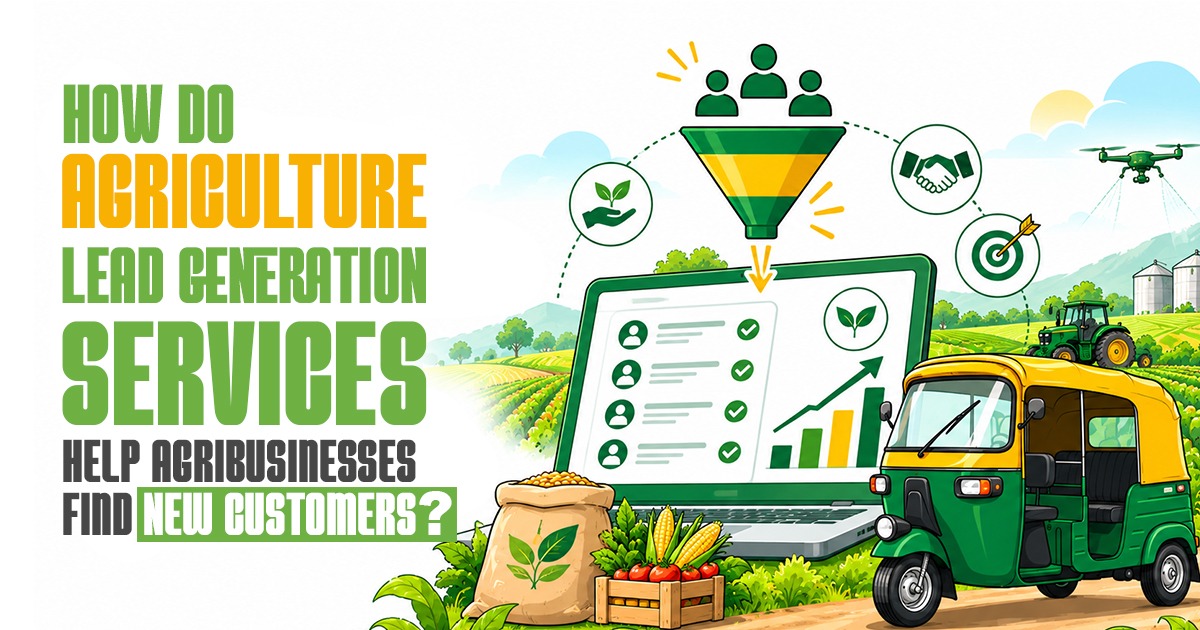
Agriculture lead generation services help agribusinesses find farmers, dealers and buyers who are actually looking for what they sell, then pass those enquiries to the sales team. Unlike general advertising, they account for seasons, regional languages and dealer-led buying chains. This article explains how they work, which channels suit which audience and what to check before hiring a provider. The IAMAI–Kantar Internet in India Report 2025 found that rural India makes up about 57% of the country’s 958 million active internet users, so agri audiences are increasingly reachable online.
Quick Summary
- A lead in agriculture can be a farmer, dealer, distributor or bulk buyer, and each needs a different approach.
- Seasonality, language and dealer networks make generic ads inefficient.
- The usual flow is audience research, channel selection, an enquiry offer, lead screening and follow-up.
- Results should be measured on qualified leads and sales, not clicks.
- Avoid any provider that guarantees a fixed number of leads.
What Are Agriculture Lead Generation Services?
Agriculture lead generation services are marketing activities that attract and capture enquiries from potential customers of agri businesses, such as farmers, dealers, distributors, processors and institutional buyers. They combine targeted ads, search visibility, content and enquiry forms or calls, then qualify each enquiry before it reaches sales.
“Lead” means different things across the sector. It might be a farmer asking for a product demo, a dealer asking about a distributorship or a food processor requesting bulk pricing. A good provider defines a qualified lead before the campaign starts, usually by location, crop or business type, and purchase timing.
Why Is Finding New Customers Harder in Agriculture?
Agriculture sales are seasonal, regional and often routed through dealers, so general advertising wastes money. Buyers decide around sowing and harvest cycles, speak different languages across states, and may lean on a local retailer’s advice before choosing a brand. Lead generation has to reflect these realities to produce useful enquiries.
Four factors shape campaign planning:
- Seasonality: Demand for seeds, crop protection and equipment peaks at specific times, so campaigns need to start before the season, not during it.
- Language: The IAMAI–Kantar 2024 report highlighted Indic languages as a growing driver of internet use, so local-language creative is worth testing.
- Dealer layer: Many products sell through retailers, so a farmer enquiry often needs routing to the nearest dealer.
- Shared devices: The 2025 report found that 18% of internet users go online through someone else’s mobile, nearly 80% of them in rural areas. Offering a call or WhatsApp option, not just a form, can help capture these enquiries.
How Do Agriculture Lead Generation Services Find New Customers?
They identify the target audience, choose channels where that audience spends time, run ads or content with a clear offer, and capture enquiries through forms, calls or WhatsApp. Leads are then screened by location, crop or business type and passed to sales with enough detail to follow up quickly.
In practice, the process runs in five steps:
- Define the audience, region and product focus.
- Build a simple offer, such as a demo, sample, price list or dealer enquiry.
- Launch campaigns on the channels that fit that audience.
- Capture and screen enquiries.
- Review results and adjust each month.
| Channel | Best for | Typical enquiry route |
| Google Search and SEO | Buyers actively searching for a product or supplier | Landing page form, call |
| Meta (Facebook, Instagram) ads | Local farmer awareness, demos, product launches | Lead form, WhatsApp click |
| YouTube and short video | Product education and how-to content | Link to enquiry page |
| Processors, exporters, institutional buyers | Lead form, direct message | |
| Events and dealer meets | Dealers and distributors | QR code sign-up |
Video matters here: the same IAMAI report found that 588 million users, or 61% of India’s internet users, watched short-form video in 2025, with rural users marginally ahead of urban ones.
How Does Agribusiness Lead Generation Differ by Audience?
Agribusiness lead generation differs by audience. Farmers tend to respond to simple, local-language content showing results and usage, dealers want margins, support and territory clarity, and B2B buyers look for specifications, certifications and reliability. One campaign rarely suits all three, so each group needs its own message and enquiry path.
- Farmers: Short videos, crop-specific tips and a phone or WhatsApp option.
- Dealers and distributors: Territory details, margin structure and a clear application process.
- B2B buyers: Product specifications, quality documents and sample requests.
Mixing these audiences in one campaign usually produces confusing messages and low-quality leads.
How Do You Turn Agricultural Leads Into Customers?
Respond fast, qualify the lead, and follow up through the channel the person used. Check location, crop or business need and purchase timing, then route the lead to the right dealer, field team or sales manager. Track each enquiry to the final sale so you can see which campaigns actually produce customers.
Two habits make the biggest difference. First, set a response-time target, since an enquiry that waits days is easy to lose. Second, record the outcome of every lead, including why it did not convert. Over a season, that data shows which regions, messages and channels deserve more budget.
How Do You Choose an Agriculture Digital Marketing Agency?
Choose an agriculture digital marketing agency that shows relevant agri case studies, understands seasonal and regional targeting, explains how leads are qualified and reports on enquiries and cost per lead, not just clicks. Ask what you will own, how often you will review results, and avoid anyone guaranteeing a fixed number of leads.
Before signing, confirm:
- Whether ad accounts and landing pages will belong to you.
- How leads are delivered, such as CRM, sheet or WhatsApp, and how fast.
- Whether ad spend and management fees are quoted separately.
- Whether the team can create regional-language creative.
An agriculture marketing agency in India should also be able to explain how it handles dealer-led sales, not only direct-to-farmer enquiries.
Are Agriculture Lead Generation Services Worth It for Agribusinesses?
Yes, when the business has a clear product, defined audience and a team ready to follow up quickly. Agriculture lead generation services bring structure to enquiries, but results depend on offer, seasonality, budget and response speed. Measure success by qualified leads and sales, not by impressions or clicks.
Start small: one product, one region, one or two channels, and a monthly review. Expand only after the numbers show what works.
Sociostreet is a digital marketing agency in Kalkaji, New Delhi, with an agriculture marketing page on its site. Its homepage lists a campaign for Dhanuka Agritech, “India Ka Pranaam, Har Kisan Ke Naam”, which it says won Gold in the Rural Marketing category at the Agency Reporter Programmatic Asia Awards 2026. That was a brand campaign rather than a lead generation programme, but it shows experience of the rural audience. If you are planning an agri lead campaign, talk to the team about your product, region and goals.
FAQs
What do lead generation services for agriculture companies include?
They typically include audience research, search and social ads, landing pages or enquiry forms, WhatsApp and call tracking, lead qualification and reporting. Some providers also add content, SEO and dealer-locator pages to support ongoing enquiries.
Which channels work best to generate leads for agribusinesses?
It depends on the audience. Google Search suits buyers actively looking for suppliers, Meta and YouTube suit farmer awareness and product education, and LinkedIn suits B2B and export buyers. Test two or three channels and keep the ones that produce qualified enquiries.
What does it cost to generate agri leads?
Costs vary by channel, region, season and competition. Agencies usually charge a management fee separate from ad spend, and cost per lead can change sharply between peak and off-season. Ask for a written breakdown and a realistic testing budget.
How long does it take to start getting leads?
Paid campaigns can generate first enquiries within weeks, though quality usually improves after testing and optimisation. SEO and content take longer, often several months. Timelines depend on season, budget and offer, so treat any fixed promise with caution.
Can a small agri business use these services?
Yes. A small agribusiness can start with one product, one region and one or two channels, then expand once it knows which messages work. Starting narrow keeps budgets manageable and makes results easier to measure.
Do farmers actually find suppliers online?
Increasingly, yes, though dealers and local retailers still matter. The IAMAI–Kantar 2025 report counts about 548 million active rural internet users, so online and offline efforts should work together.
What is a qualified lead in agriculture?
A qualified lead is an enquiry from someone in your serviceable area with a relevant crop or business need and a near-term purchase intent. Screening for these factors saves sales time and keeps reporting honest.
Should ads and landing pages be in regional languages?
Yes, wherever your audience prefers it. Because Indic languages are a growing factor in internet use, per the IAMAI–Kantar 2024 report, test local-language ads and pages against Hindi or English versions and compare enquiry quality.