


- kunal
- AI in web design, AI SEO, AI web design, AI web design trends 2026, digital marketing, SEO Services Company, website design
- 0 Comments
- 388 Views
A few years ago, a business could launch a website, update it occasionally, and leave it alone for long stretches.
That approach is becoming harder to justify.
People now search differently. They ask longer questions, compare several options before contacting a company, use AI tools to research products, and expect websites to give them useful answers quickly. Google itself has expanded AI Overviews and AI Mode, with Gemini models playing a growing role in how people explore information through Search.
That shift is changing the conversation around website design.
Businesses are no longer asking only, “Does our website look modern?”
They are asking better questions:
- Can people find what they need without hunting for it?
- Does the site explain our expertise clearly?
- Can visitors move from a question to an enquiry easily?
- Is our content useful enough to be discovered through AI-powered search?
- Can the website adapt as customer expectations change?
Those questions matter more than adding another animation to the homepage.
The Website Is Becoming Part of the Sales Conversation
A potential customer may never speak to a salesperson before forming an opinion about a company.
They may discover the brand through Google, ask an AI assistant about it, visit its website, read a case study, check reviews, and return several days later before making contact.
The website sits somewhere in the middle of that journey.
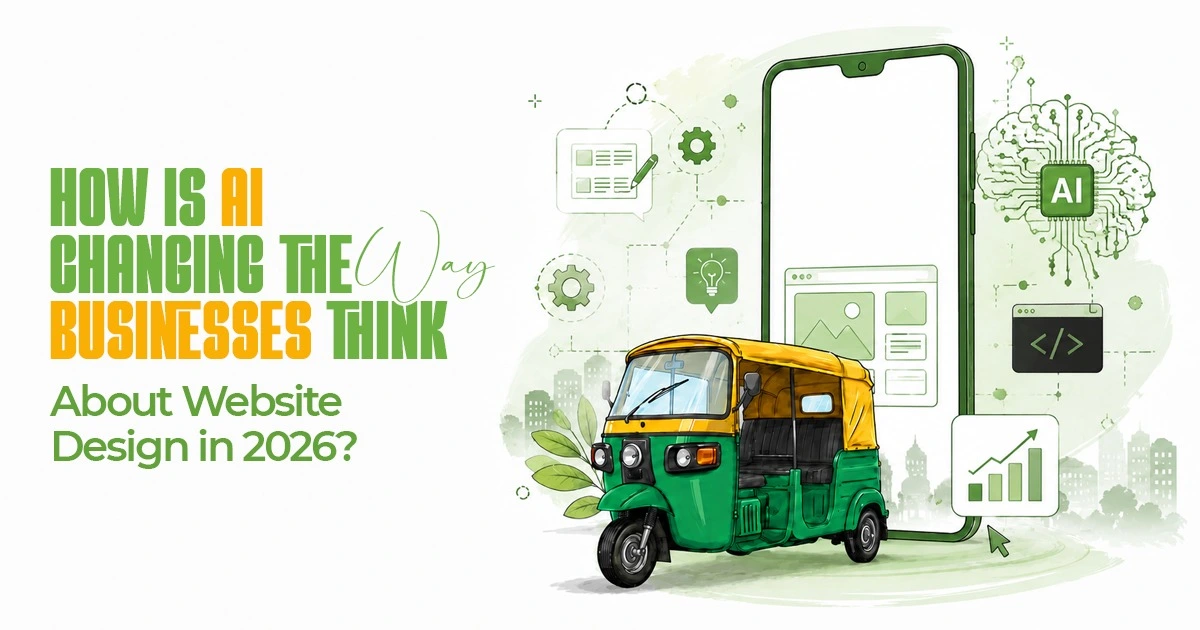
This is why AI web design is becoming less about generating attractive pages and more about designing an experience that supports how people actually research and make decisions.
Imagine someone looking for a branding agency.
They are unlikely to want a page that simply says:
“We create innovative solutions for modern businesses.”
They want to know what the agency actually does, who it works with, what its process looks like, what results it has achieved, and whether it understands their particular problem.
A better website answers those questions before the visitor has to ask.
That is a design improvement, even if no visible AI feature exists.
AI Is Changing What Happens Behind the Screen
Some of the biggest changes are not obvious to visitors.
Design teams can now use AI to explore layouts, organise information, create initial copy, analyse research, develop prototypes and test different approaches much faster than before.
That changes the economics of the design process.
Instead of spending hours producing every first draft manually, a designer can explore several directions quickly and spend more time deciding which direction actually makes sense.
But there is an important distinction between faster production and better thinking.
AI can produce five homepage concepts in seconds.
It cannot automatically know which concept fits a company’s reputation, audience, pricing model, or competitive position.
It can write a service description.
It does not necessarily know which customer objection that description needs to overcome.
So the role of the designer is changing rather than disappearing. Less time can be spent on repetitive production, while more attention can go into judgement, research, brand decisions and refining the customer journey.
AI in Website Design Is Making “User Intent” Harder to Ignore
A website visitor does not arrive with a design brief.
They arrive with a problem.
Someone searching for an accounting firm may want help with tax planning. Another visitor may simply want to check whether the firm handles startups. A third may already be comparing prices.
All three people can land on the same homepage.
This is where AI in website design becomes interesting.
Behavioural data and AI-assisted analysis can help businesses identify patterns in what visitors search for, which pages they visit, where they stop, and what information they repeatedly request.
That information can influence the structure of the site.
Instead of organising pages around how the company is internally structured, the website can be organised around what customers are trying to accomplish.
That sounds obvious, but many business websites still make visitors work far too hard to find basic information.
The Homepage Is Losing Some of Its Old Importance
There was a time when almost every website strategy revolved around the homepage.
Get the homepage right, and everything else would follow.
Today, a visitor can arrive through a blog post, product page, service page, LinkedIn post, Google result, AI-generated recommendation, or shared link.
That means every important page needs to work independently.
A service page should explain the service.
A case study should demonstrate credibility.
A product page should answer buying questions.
An article should genuinely solve the problem behind the search.
This matters for AI search as well.
Google’s current documentation says AI Overviews and AI Mode use existing Search systems to find relevant supporting pages. There is no separate “AI SEO” trick or special markup that guarantees inclusion. Strong fundamentals still matter.
In practical terms, businesses should stop thinking about the website as one digital brochure and start treating it as a collection of useful entry points.
AI UX Design Is About Removing Friction
A common mistake is assuming that AI UX design means putting a chatbot on every website.
It doesn’t.
Sometimes the best use of AI is invisible.
For example, an e-commerce website might improve product recommendations based on browsing behaviour.
A B2B company might use intelligent search so visitors can find information using natural language instead of guessing the exact page title.
A service business might use an automated assistant to handle routine questions before passing complicated enquiries to a person.
The important question is not:
“Where can we add AI?”
It is:
“Where are customers experiencing unnecessary friction?”
That distinction can save businesses from investing in technology simply because it is fashionable.
AI User Experience Still Needs a Human Escape Route
Automation is useful until the customer has a question that falls outside the script.
That is why good AI user experience should always leave room for human assistance.
A visitor dealing with a complicated purchase, high-value service,e or sensitive issue may not want a chatbot to make the final decision.
They may want a person.
Businesses should therefore design AI interactions with clear escalation points:
AI assistance → relevant information → human support when needed
The objective is not to remove people from the experience.
It is to allow people to spend less time answering repetitive questions and more time handling situations where judgement matters.
What AI Web Design Trends 2026 Actually Mean for Businesses
There is plenty of discussion around futuristic interfaces, AI-generated websites, and autonomous digital experiences.
Some of those ideas will become useful. Others will remain mostly demonstrations.
For businesses, the more practical AI web design trends 2026 are easier to identify.
Smarter site search
Visitors can increasingly search using natural language rather than exact product or service terminology.
More useful personalisation
Content and recommendations can be adjusted according to relevant behavioural signals.
Faster design iteration
Teams can test more concepts before committing to a final direction.
AI-assisted customer support
Routine questions can be handled without requiring a member of staff every time.
Better content workflows
Research, outlines, editing and content variations can be accelerated while human review remains essential.
Websites built for multiple discovery paths
A page may need to work for someone arriving from Google, social media, an AI assistant or a direct recommendation.
These changes are more meaningful than simply putting “AI-powered” on a website’s homepage.
AI for Business Websites Should Have a Business Case
Before adding an AI feature, ask what it is expected to improve.
If customer support receives hundreds of repetitive questions every month, automation could make sense.
If visitors struggle to find products, smarter search might be worthwhile.
If the sales team spends hours sorting basic enquiries, an intelligent qualification process could help.
If customers frequently abandon an application form, behavioural analysis might identify where the process is going wrong.
But if the only reason for adding an AI chatbot is that competitors have one, pause.
AI for business websites should be treated like any other investment. There needs to be a problem, a proposed solution, and a way to judge whether the change worked.
The New SEO Question Is Not “How Do We Rank for AI?”
This is an important distinction in 2026.
Businesses sometimes approach AI search as though they need an entirely new optimisation system.
Google’s own guidance says the opposite: existing SEO fundamentals continue to form the basis for visibility in AI features. Pages need to be crawlable, indexable and useful, with important information available in text and a good overall page experience.
Google has also published specific guidance encouraging unique, valuable, non-commodity content for generative AI search.
So the smarter question is:
“Would an independent expert consider this page genuinely useful when answering a customer’s question?”
If the answer is no, adding more keywords will not solve the underlying problem.
This Is Where SEO and Website Design Meet
A beautiful website with weak information architecture can struggle in search.
A technically strong website with thin, generic content can struggle too.
And a site with excellent rankings but a confusing conversion journey may attract visitors without generating enough business.
That is why digital marketing should not be separated from the website build.
The people handling SEO should understand the site’s structure.
The designers should understand the audience.
The content team should understand search intent.
The developers should understand performance and accessibility.
When these disciplines work separately, businesses often end up fixing the same website several times.
A good SEO services company should therefore look beyond keywords and rankings. It should consider how content, technical performance, internal linking, page structure and conversion paths work together.
Original Experience Is Becoming More Valuable
There is another reason businesses should be careful with AI-generated content.
AI can summarise information that already exists online very efficiently.
That also means the internet can become saturated with pages saying essentially the same thing.
Google’s guidance specifically stresses valuable, unique content and warns against producing large amounts of low-value material simply through automation.
For businesses, the answer is not complicated.
Talk about things you actually know.
Show real projects.
Explain decisions.
Include original data where available.
Share lessons from customer work.
Discuss mistakes.
Answer questions your sales team hears repeatedly.
Explain how your process works.
Those details are difficult to manufacture convincingly because they come from experience.
A generic article can explain what website design is.
A credible business can explain what it learned after redesigning 30 client websites and discovering that visitors repeatedly missed the same piece of information.
The second type of information is far more valuable.
Websites Need to Work for People First
AI may be changing how websites are discovered, but the final interaction is still often human.
Someone has to read the page.
Someone has to decide whether the company looks credible.
Someone has to fill in the enquiry form.
Someone has to decide whether to make the purchase.
That is why basic design principles remain important:
- Clear navigation
- Readable typography
- Fast loading
- Mobile-friendly layouts
- Strong contrast
- Useful calls to action
- Accessible content
- Straightforward forms
- Clear pricing or service information where appropriate
Technology should make these experiences better, not bury them under unnecessary features.
What Businesses Should Do With Their Existing Website
Not every company needs a completely new site.
Start by looking at what is already happening.
Check your analytics.
Talk to the sales team.
Read customer emails.
Review search queries.
Look at your most visited pages.
Find pages with high traffic but poor conversion.
Identify questions customers keep asking.
Then decide what actually needs fixing.
For one company, the answer may be a better service-page structure.
For another, it may be outdated content.
Another may need better mobile performance.
And some businesses may genuinely benefit from AI-powered search or support.
Sociostreet’s work across branding, digital marketing and online growth reflects an important principle here: the website should support the wider customer journey rather than operate as an isolated design exercise.
The Website of 2026 Doesn’t Need to Look Like a Science-Fiction Interface
This may be the most useful point to remember.
AI is not automatically making good websites more complicated.
In many cases, it is pushing businesses in the opposite direction.
People want answers sooner.
They want less friction.
They want relevant information.
They want evidence that a company understands their problem.
They want to know what to do next.
A website that delivers those things clearly may outperform a technically impressive site filled with features nobody asked for.
The real change in website design is therefore not that every business needs an AI-powered interface.
It is that businesses have fewer excuses for designing experiences around internal assumptions rather than customer behaviour.
AI can help teams research faster, identify patterns, personalise useful interactions and automate routine work.
Human expertise still determines whether those capabilities are used well.
What Will Matter Most Going Forward?
The strongest business websites will probably not be the ones with the most AI features.
They will be the ones with the clearest understanding of their customers.
They will explain difficult subjects well. They will make evidence easy to find. They will provide useful answers. They will load quickly. They will work across devices. They will give search engines and AI systems enough context to understand what the business actually does.
And when a visitor is ready to take action, they will make that step obvious.
That is a much more practical way to think about the future of website design.
AI is changing the tools, the search environment and the expectations around digital experiences. It is not changing the basic reason a business needs a website:
to help the right people understand, trust and choose the business.
The companies that keep that principle at the centre of their digital strategy will be better positioned to benefit from whatever the next phase of AI brings.
FAQs
How is AI changing website design in 2026?
AI is changing how websites are researched, created, personalised and maintained. It can help businesses understand visitor behaviour, improve search, automate routine interactions and test design ideas faster. The biggest shift, however, is toward websites that respond more closely to what visitors are actually trying to accomplish.
Will AI replace website designers?
No. AI can automate parts of the production process, but deciding how a brand should communicate, what information customers need, and how a website should guide people still requires human judgement. Designers are likely to spend less time on repetitive production and more time on strategy and problem-solving.
What is AI web design?
AI web design means using artificial intelligence at different stages of creating or improving a website. This might include generating design concepts, analysing user behaviour, assisting with content, creating prototypes, or powering features such as intelligent search and recommendations.
How does AI improve the user experience of a website?
AI can make an experience more relevant by helping visitors find information, receive recommendations, or get answers without navigating through unnecessary pages. However, AI user experience works best when it removes friction rather than adding technology for its own sake.
What are the major AI web design trends 2026?
The practical developments include natural-language search, personalised recommendations, AI-assisted design workflows, conversational support, automated content processes and websites that can better respond to visitor intent. Businesses should assess these developments according to customer needs rather than adopting every new feature.
Should every business add an AI chatbot to its website?
No. A chatbot makes sense when customers have recurring questions that can be answered accurately and efficiently. If visitors already find information easily, an unnecessary chatbot can create another layer of interaction instead of improving the experience.
How can AI help with AI UX design?
AI UX design can use behavioural information to identify patterns, uncover friction, and support more relevant journeys. For example, a website could recommend related information based on what someone has already viewed. Human testing is still important because analytics cannot explain every reason behind user behaviour.
Does AI change SEO for business websites?
It changes the search environment, but it does not eliminate the fundamentals. Google says the same core SEO practices remain relevant to AI Overviews and AI Mode, including crawlability, indexability, useful content, internal linking, and good page experience.
How can a digital marketing agency prepare a website for AI search?
Start with fundamentals: make important content crawlable, structure information clearly, improve page experience, demonstrate genuine expertise, and publish information that adds something beyond what is already available online. A good digital marketing and SEO strategy should support both traditional search visibility and the newer ways people discover information through AI.
What does AI for business websites actually mean?
AI for business websites means applying AI to a specific business requirement, such as improving internal search, answering routine customer questions, recommending products, or helping qualify enquiries. The feature should have a measurable purpose rather than being added simply because AI is popular.