

- kunal
- Creative Agency in Delhi, delhi agency, digital marketing, enterprise branding agency
- 0 Comments
- 24 Views
Brand managers know this scene all too well. The head office approves a beautiful new logo. Three months later, a franchise in Jaipur stretches it to fit a banner. The Pune team alters the blue. A distributor prints brochures using a typeface nobody recognizes. They mean no harm. There is simply no process to follow.
This is the opportunity a creative agency in Delhi gets hired to fill. So how does a creative agency in Delhi build a scalable visual identity? The process begins with understanding how your company runs, rather than drawing logos. Then it helps determine what your brand stands for, converts it to a set of visual standards, implements them across materials and provides your teams with a system they will find helpful, rather than burdensome.
In this post, we will outline that process and show what components a scalable brand identity system contains. We will learn how large organizations manage to keep their brand steady across various teams and locations.
What is a Scalable Brand Identity System?
A scalable brand identity system is a set of rules and guidelines to allow a brand to grow without losing its character. The key word is rules. While the principles can be flexible, designers in Mumbai and a store owner in Lucknow can interpret them differently and still adhere to the system.
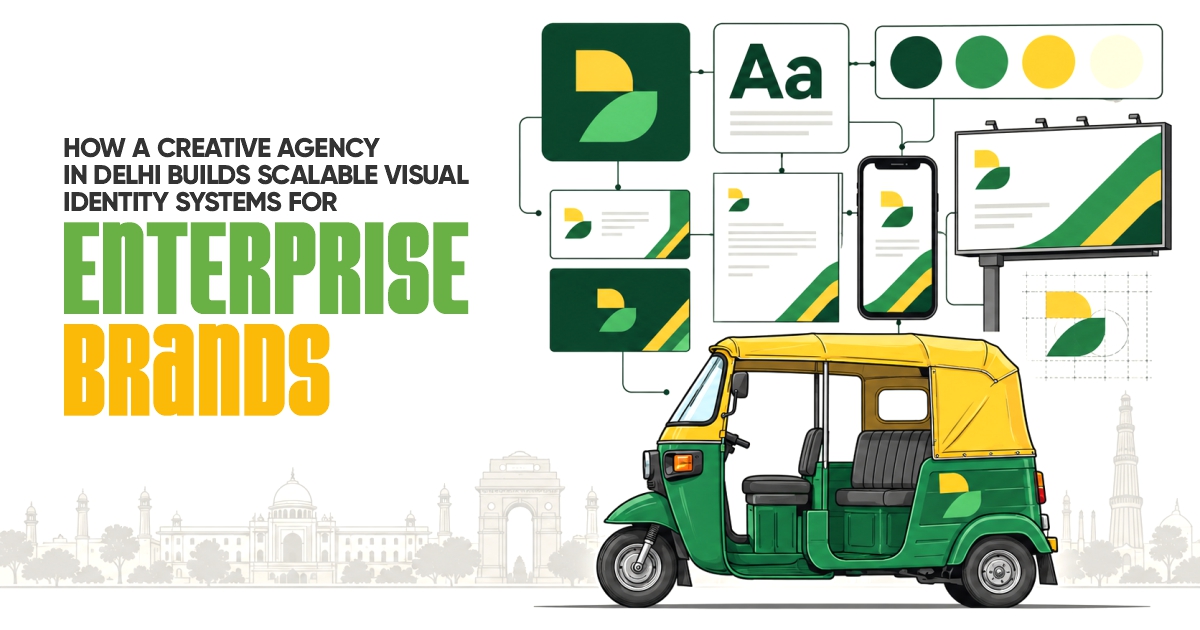
In the real world, this covers a brand’s logo, color, typography, imagery, and motion and guides how to use them in conjunction with each other.
Logo vs. A complete visual identity system
People confuse logos and visual identity systems all the time, including when writing design briefs. A logo is a single asset. A visual identity system is made up of many assets.
A logo is not a visual identity system, even if they are used together. A logo can tell customers who you are. Still, a visual identity system tells customers how you look and sound everywhere else: on packaging, a banner on your LinkedIn profile, an app icon, a billboard. A team can create thousands of different assets without guidance if all they have is a logo. However, most of those decisions will be made for them if a visual identity system is given to them.
Why Enterprise Brands Need Consistent Visual Identity Guidelines
The consistent use of a brand’s identity elements across the business is especially important at the enterprise level. Consistency helps forge trust with customers, and a lack of consistency undermines it. You want customers to see your company as one they can trust, especially if you’re selling a big brand.
There are a lot of benefits to strict brand identity guidelines. Using the same elements over and over helps people quickly recognize your brand. It helps employees spend less time creating elements from scratch and waiting for approval on work that is repetitive in nature. Employees can feel confident they are meeting brand requirements, and fewer Brand materials need to be reworked or reprinted. Ultimately, strong brand identity guidelines help a company be efficient with the money they spend on Brand materials, and it helps customers, investors, and partners feel confident they are working with a well-run business.
If your company employs a lot of franchisees, dealers, and regional offices, it’s even more important to have strong brand identity guidelines. Usually, the head office can’t review every piece of material created by the regional offices, dealers, and franchisees. Still, strong brand identity guidelines can help ensure the people creating the material know the standards.
How a Delhi Agency Builds the System, Step by Step
Design agencies are different, but the steps a good agency takes when building a system are similar. They often begin with an audit. This is where they collect everything your brand touches. It could be the signage, the packaging, collateral, or even the uniforms. They have meetings with the leadership and regional and frontline managers to gather the areas where the brand may quietly break apart.
Next, the agency builds the strategy. This is where the personality of the brand is figured out. This happens before any design work is done. This is because, in the absence of strategy, visuals are decoration.
Next comes the design of the core identity. Stress tests are incorporated to see how the brand stands up in different situations. Does the logo work at favicon size? What about printing it on a cheap newsprint? The agency builds the system to make sure it stands up to various situations and formats.
Lastly, everything is tested, packaged and documented. Agencies in Delhi have a slight edge with this. Working with the conditions in India helps design systems that can thrive in the real world.
What a Corporate Brand Identity System Should Include
Different systems can be built to support brand identity. However, without certain elements, teams end up making things up as they go along, and that’s when drift starts to occur. There are usually a handful of elements that make a solid system. These elements are the baseline for corporate brand identity.
- Logo Suite: various versions of the logo (primary, compact, 1 color) with clear space, minimum size, do’s and don’ts
- Color: print and screen values (with contrasting pairs), Pantone, CMYK, RGB, HEX, etc.
- Typography: safe web and email font stacks
- Imagery and Icons: rules for diagrams and icons, photography and illustration style
- Layouts and Templates: documents, presentation, social, signage
- Motion and Digital: rules for UX/UI
- Tone of Voice: because words are visual
The best systems tell you what never changes (logo, core palette, type) and what can (imagery, layout, copy).
For consistency across locations and team
Brilliance is moot when no one can locate or use it. Uniformity across divisions, suppliers and cities relies as much on the means as on the end.
How can businesses ensure brand consistency across multiple locations?
Make the right thing the easy thing. Local teams should be able to edit, or at least customize, the templates for signage, posts, and other collateral. Show what can be changed (photos, wording, offers) and what should never change. Send the same spec sheet to vendors for signs and brochures, and give a quick training to new employees and agencies.
What is the best way to organize brand assets for large companies?
Put brand assets in a centralized location, preferably in a Digital Asset Management (DAM) system. Providing brand teams with easy access to approved brand assets reduces the risk of teams creating their own outdated brand assets.
Also appoint a brand guardian. This person/team may approve new brand assets and periodically audit what is in the marketplace. If there is no Brand Guardian, brand guidelines quickly become outdated.
The Challenges of Brand Evolution
How does a company keep its brand identity while progressing its brand? Brand identity encompasses a set of brand assets that are used to reflect a company’s brand. This may include a brand’s sound, color, font, etc. To protect a company’s brand recognition, a brand should seek to evolve and modernize while keeping a few core brand assets the same. Additionally, companies should roll out a change in brand identity in a staged manner. When making a change, companies should consider describing their rationale to customers in a clear, concise manner, particularly if this rationale explains that a company is evolving and modernizing.
Updating a company’s brand identity should be done in a scalable manner in which rules are modular and flexible. From a brand identity standpoint, this may allow for swapping components at a time instead of forcing a complete redesign.
Choosing the Right Enterprise Branding Partner in Delhi
Be wary of the polished portfolio when comparing creative agencies in Delhi for your big identity project. Check if they have developed systems for multi-location organizations, or if they have only launched logos. Determine if you will get templates and asset libraries, and if training will be provided, or if you will receive a PDF. Check if they can work with multiple languages, scripts and production conditions, if they start with research and if they will be there for the rollout.
The most effective partners will be able to think like an operator as well as a designer. They will understand the realities of the region and the daily challenges of the people that will be implementing the brand, and what it takes to get approvals and stay within a budget.
Final Thoughts
A scalable visual identity is infrastructure. It protects brand recognition and speeds up work. It gives a clear way for people to show up as your brand, whether they are in the boardroom or a branch office. And it is far less expensive to build scalable branding systems than to deal with the slow, expensive drip of inconsistency.
If your business has outgrown its logo and its guidelines, it’s time to talk to an enterprise branding agency that builds for scale. Get in touch with our Delhi team for a brand audit and a no-pressure conversation.